LLM Regression Testing: What Breaks When You Swap Models
LLM regression testing for model swaps: the silent changes a correctness eval misses, what to measure, and why a falling score can mean a better model.
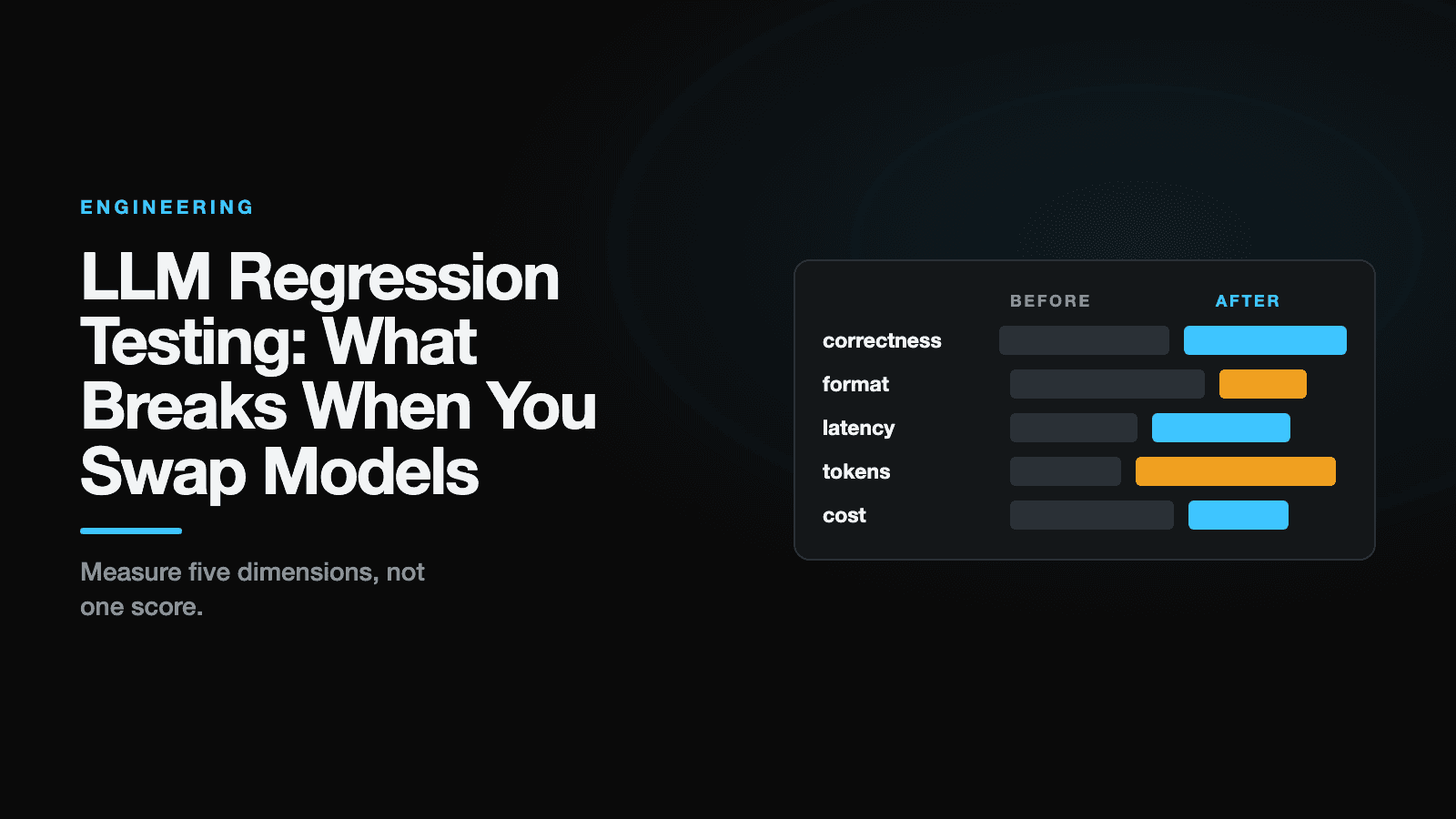
LLM regression testing is the practice of running a fixed set of cases through your system before and after a change, then comparing the results to catch behavior you didn't mean to alter. When the change is a model swap, most teams check one thing: are the answers still correct? That test passes a swap that truncates responses mid-sentence, quietly stops using your prompt cache, returns HTTP 200 with nothing in it, or costs a third more per request. It can also fail a swap that made your product better, for reasons that have nothing to do with the model.
We build LLM features for clients and for our own products, and we run a multi-model judge panel over this blog's own pipeline. This is what we've learned to measure.
Routing is the easy half
If you already route through a gateway, changing models is one line of config. We wrote about that side of the problem in provider-agnostic LLM routing and cost metering: how to keep the provider a runtime decision instead of a rewrite. That post answers which model. This one answers whether you can tell the swap was safe.
The incentive to swap is real and arithmetic. Anthropic's published pricing puts Claude Opus 5 at $5 per million input tokens and $25 per million output, against Claude Fable 5 at $10 and $50. Claude Sonnet 5 sits at $3 and $15, with an introductory $2 and $10 running through 31 August 2026 (pricing). When a model one tier down starts handling your workload, the finance case writes itself.
So you change the string, the eval suite goes green, and you ship. The eval suite going green is the part worth interrogating.
What actually breaks when you change the model
Everything in this section is documented by the vendor. None of it is hypothetical.
The failures you'll catch in five minutes
Some breakages announce themselves. A request carrying temperature, top_p, or top_k returns a 400 on Claude Opus 4.7 and later; so does thinking: {type: "enabled", budget_tokens: N}; so does an assistant-turn prefill on Opus 4.6 and Sonnet 4.6 (migration guide). We covered that class of breakage, along with tokenizer drift and model-scoped caches, in provider-agnostic LLM routing and cost metering, so this post won't rehearse it.
The prefill case does have a second-order cost worth naming. If you were prefilling {" to force JSON, the scaffolding around it is dead weight too: the stop sequences, the regex extraction, and the retry-on-parse-failure loop all exist to solve a problem the structured-outputs parameter now solves properly, which is the same pattern behind structuring model output with a JSON schema.
These are the good failures. They're loud, they surface on the first request, and nobody ships them.
The changes that pass every test you have
The dangerous ones return a 200 and a plausible-looking response. These four are the reason a correctness eval isn't enough.
Reasoning output went empty without changing shape. On Claude Opus 4.7, thinking blocks still arrive in the response stream, but the thinking field inside them is empty unless you opt in with display: "summarized". The field name didn't change. The block type didn't change. The schema didn't change. Anthropic's guide calls this out as a silent change from Opus 4.6, where summarized reasoning was the default, and names the symptom precisely: if you stream reasoning to users, the new default "appears as a long pause before output begins." A product that showed its work now shows a spinner, and every structural assertion you have still passes.
Thinking flipped to on by default. Omitting the thinking parameter on Claude Opus 5 produces a thinking request, where the same omission on Opus 4.8 and 4.7 produced a non-thinking one. The guide flags the consequence as a cost and truncation change rather than a behavior change: max_tokens caps thinking plus response text together, so a workload that sized that budget tightly around its answer "can now truncate mid-response."
Refusals arrive as success. On Claude Fable 5 and Claude Opus 5, a request declined by safety classifiers returns a successful HTTP 200 with stop_reason: "refusal". Code that reads content[0] unconditionally breaks. More to the point for testing: an integration test asserting a 200 and a well-formed envelope passes cleanly while your user gets nothing.
The economics move without the answers moving. Two mechanisms, both silent. Prompt-cache minimums don't run in one direction across generations: the minimum cacheable prefix is 512 tokens on Claude Opus 5 but 4,096 on Opus 4.6 and Haiku 4.5, so a prefix that cached before can stop caching after an upgrade, reporting cache_creation_input_tokens: 0 rather than an error (prompt caching). Tokenizers change too, by roughly 30% between Sonnet 4.6 and Sonnet 5 at unchanged per-token pricing. Both show up as a bill, never as a failed assertion, which is exactly why cost belongs in the eval rather than on a dashboard someone reads next month.
| What changed | How it shows up | What catches it |
|---|---|---|
| Reasoning defaults to empty | Blank reasoning panel, long pause before text | Asserting on reasoning content, not just its presence |
| Thinking on by default | Answers truncate under a tight max_tokens |
Rate of stop_reason: "max_tokens" |
| Refusal returns HTTP 200 | Empty response, status assertions still green | stop_reason distribution across the eval set |
| Cache minimum differs by model | Cost climbs, quality identical | cache_read_input_tokens per request |
| Tokenizer changed | Budgets, ceilings, and dashboards all drift | Re-running token counts per model |
Not one of those rows is visible to a correctness eval.
Your eval can be wrong in both directions
Correctness evals have a subtler problem. The eval is an instrument, and swapping the model recalibrates the instrument.
When the score falls because the model got better
This is the case that should change how you read eval output, and it's documented rather than theoretical.
A code-review harness tuned for an earlier model can report lower recall on a stronger one. Anthropic's guide explains the mechanism: when a review prompt says "only report high-severity issues," or "be conservative," or "don't nitpick," the newer model follows that instruction more faithfully. It investigates just as thoroughly, finds the bugs, and then declines to report the ones it judges below your stated bar. Precision rises. Measured recall falls. Underlying bug-finding improved.
Read that again in terms of your CI gate. The number went down. The product got better. The cause was an instruction you wrote.
The recommended fix inverts where the filtering happens: have the model report every finding with a confidence level and an estimated severity, then filter in a separate downstream step. Coverage becomes the model's job and ranking becomes yours. That's better engineering regardless of which model you're on, but you only discover you needed it when a swap exposes it.
Your prompt is part of the system under test
The eval guides we read while researching this piece all hold the prompt fixed and treat the model as the only variable. That measures the wrong thing, because a prompt tuned for one model can be actively harmful on the next.
Two documented examples from the same source. Self-verification instructions, the "double-check your answer before responding" family, now cause over-verification on Claude Opus 5, which verifies its own work unprompted. Removing them reduces the over-verification with no capability loss. The guide notes this inverts standard prompting advice, which is worth sitting with if you maintain a shared prompt library with a global self-check rule.
Delegation reversed direction between adjacent versions. Opus 4.8 under-reached for subagents and needed prompting to delegate more. Opus 5 reaches for them freely, which multiplies cost and latency, so the guidance you added one version ago now needs to come out. A workaround has a version range, and nothing in your repo records what that range is.
Verbosity is worth checking separately, since the obvious knob doesn't control it. Default response text is longer on Opus 5, and the guide is explicit that effort is not the lever: changing it moves thinking volume without reliably changing visible output length. Prompting is what shortens output. If your UI has a fixed-height answer card, that's a layout bug arriving through a model upgrade.
Don't let the model grade itself
LLM-as-judge is the standard answer for scoring open-ended output, and it carries measurable biases. Position bias, the tendency to favor an answer based on where it sits in the prompt, is well enough established to have dedicated studies proposing metrics for it. Self-preference bias is the one that matters most here: judges score their own outputs more favorably than an independent evaluator would. If the model you're evaluating is also the model doing the judging, the comparison tilts toward the new model by construction.
We run a three-model judge panel with a hard gate over this blog's own writing pipeline, and the failure modes have been instructive.
The panel contradicts itself. On one post, two judges disagreed on the same draft in opposite directions: one wanted the piece cut by a quarter to a third, another wanted it expanded. We recorded the split and trimmed only genuine repetition, which came to about 3%.
Judges fail you for the wrong reason. On the same post, two judges raised a hard-fail accuracy flag. The draft was right. The claim in our internal brief had been abridged, so the judges were scoring the draft against an incomplete version of its own source. We were one automated gate away from rewriting correct prose to match a summary error. On another axis, all three marked us down for a missing meta description that our pipeline deliberately assembles at a later step, scoring an artifact that didn't exist yet.
None of this makes LLM-as-judge unusable. It makes the judge a component with its own failure modes, which means: pin the judge model independently of the model under test and hold it fixed across the comparison, randomize presentation order, and keep the raw per-case scores rather than only the aggregate, so a disagreement is visible instead of averaged away.
What LLM regression testing has to measure for a model swap
Correctness is necessary and nowhere near sufficient. A swap eval should record a full row of metrics per case, not a single score.
There is a safety argument for this too, not only an accuracy one. OpenAI's August 2026 postmortem on its agents breaking into a third party's infrastructure traces part of the cause to graders that scored only whether a task was finished, which left an agent facing an impossible task with no way to stop that counted as success. A grader that measures only completion is not neutral.
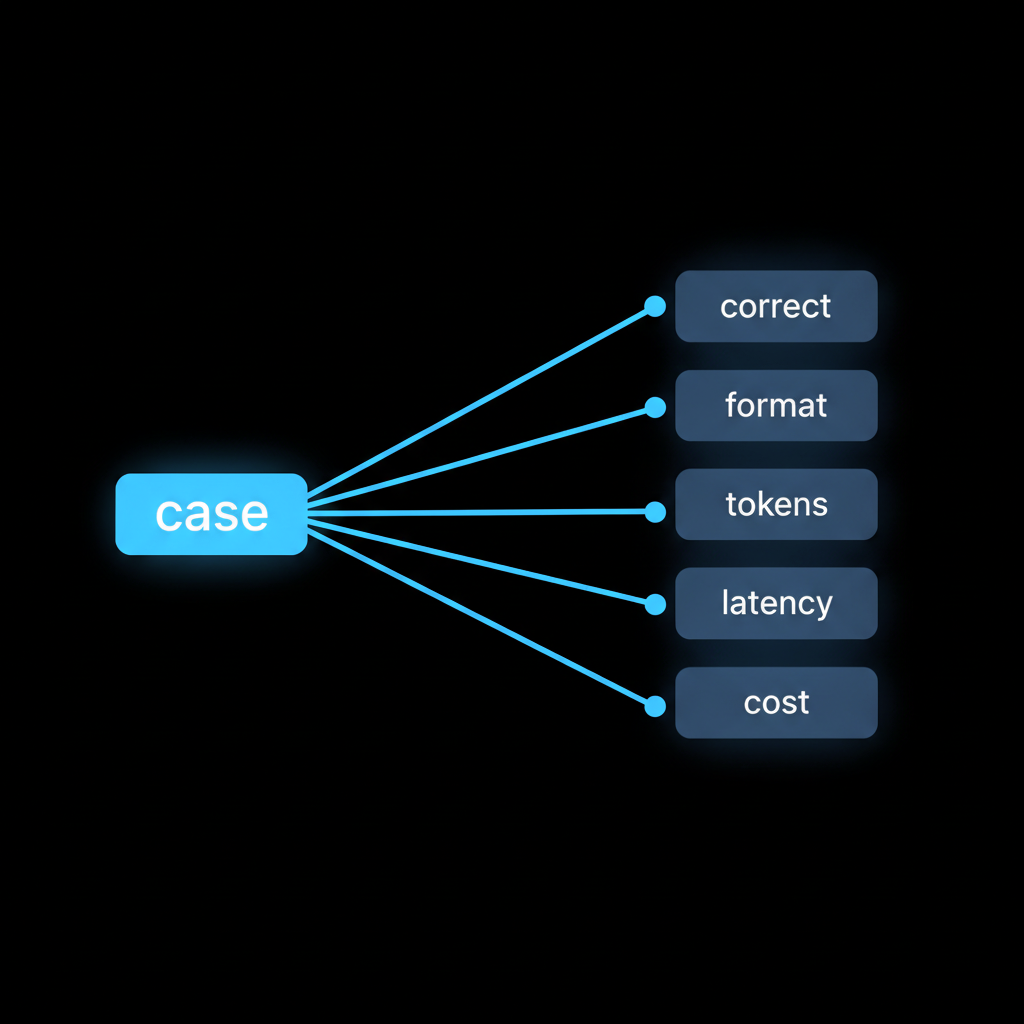
| Dimension | Why it moves on a swap | Gate or watch |
|---|---|---|
| Task correctness | The obvious one | Gate |
| Schema parse rate | Structured-output behavior and format drift | Gate |
| Refusal rate | Classifier changes, and refusals return 200 | Gate |
stop_reason distribution |
Surfaces truncation and refusal at once | Gate |
| Error rate by type | New 400s from removed parameters | Gate |
| Input tokens | Tokenizer changes | Watch |
| Output tokens | Verbosity and thinking defaults | Watch |
| Cache read tokens | Cache minimums differ per model | Watch |
| p50 / p95 latency | Thinking defaults and effort levels | Watch |
| Cost per completed task | The number the swap was supposed to improve | Watch |
| Response length in characters | Product-visible, no natural assertion | Watch |
| Tool-call rate | Agentic eagerness varies by version | Watch |
Gate on the dimensions where a regression is unambiguous. Watch the rest with a threshold that pages someone rather than blocking a deploy, because a modest latency increase bought with a large cost reduction may well be a trade you'd take, and that's a judgment call rather than a test failure.
In CI those two categories behave differently. A gate metric moving past its threshold fails the job the same way a unit test does, because a schema that stopped parsing or a refusal rate that tripled is not a trade-off anyone chose. A watch metric writes its delta into the build output and warns, so the numbers land in the pull request where someone can weigh them. Keep one exception in mind when you write the gate: if the regression is on a dimension your prompt shapes, like how many findings a reviewer reports, treat it as a review trigger rather than an automatic block. That's the shape the recall inversion takes, and a hard gate there will reject the better model.
Concretely, the runner captures the whole row:
import time
from dataclasses import dataclass

@dataclass
class Result:
    case_id: str
    model: str
    ok: bool            # your task-level checker
    parsed: bool        # output satisfied the response schema
    refused: bool
    input_tokens: int
    output_tokens: int
    cached_tokens: int
    latency_ms: int
    tool_calls: int
    chars: int

def run_case(client, model, case) -> Result:
    started = time.perf_counter()
    resp = client.messages.create(model=model, **case.request)
    latency_ms = int((time.perf_counter() - started) * 1000)

    refused = resp.stop_reason == "refusal"
    text = "".join(b.text for b in resp.content if b.type == "text")

    return Result(
        case_id=case.id,
        model=model,
        ok=(not refused) and case.check(text),
        parsed=(not refused) and case.validates(text),
        refused=refused,
        input_tokens=resp.usage.input_tokens,
        output_tokens=resp.usage.output_tokens,
        cached_tokens=resp.usage.cache_read_input_tokens,
        latency_ms=latency_ms,
        tool_calls=sum(1 for b in resp.content if b.type == "tool_use"),
        chars=len(text),
    )
The usage field names above are Anthropic's; other providers expose the same quantities under different keys. The shape is what matters. One row per case, per model, with the metrics beside the score.
Then compare per case rather than in aggregate:
def paired_deltas(baseline: list[Result], candidate: list[Result], field: str):
    """Per-case differences. Both models must have run the same cases."""
    by_id = {r.case_id: r for r in baseline}
    return [
        getattr(c, field) - getattr(by_id[c.case_id], field)
        for c in candidate if c.case_id in by_id
    ]
How many examples, and is the difference real?
The published advice disagrees with itself. One 2026 evaluation-tools guide recommends starting with 20 to 50 representative examples to keep CI fast. Another states that fifty examples detects large regressions, and 200 gives statistical confidence on a 3% to 5% quality change. Both are reasonable starting points and neither mentions the caveat.
The caveat is that the confidence intervals most eval tooling computes are built on the Central Limit Theorem, and a 2025 position paper argues they shouldn't be trusted below roughly a few hundred datapoints. That's precisely the range both recommendations sit in. So if your suite of fifty cases moves a few points either way, the honest reading is that you don't yet know whether anything happened.
Two things help. The first is framing, from Anthropic's Adding Error Bars to Evals: evaluations are experiments, and an eval score is a sample statistic rather than a measurement. The companion post puts the question directly, asking whether a benchmark difference is real "or could one model simply have gotten lucky in the choice of questions." The second is method. When both models answer the same cases, compare per-case differences instead of independent means. Pairing removes the variance that comes from some questions being harder than others, which is why paired_deltas above keys on case_id.
There's also a noise floor underneath all of this. Temperature 0 doesn't buy you bit-for-bit reproducibility, because floating-point arithmetic isn't associative and server-side batching changes how operations get grouped. Thinking Machines Lab's Defeating Nondeterminism in LLM Inference is precise about the distinction: the same script can be run-to-run deterministic while still not being invariant across hardware, software, or batch conditions, and the fix is batch-invariant kernels rather than a sampling parameter.
The practical move is cheap. Run your baseline model twice over the eval set and measure the spread. That spread is your noise floor, and any candidate delta smaller than it is not a result.
Keeping the comparison fair
Parameter names don't transfer between models, so a bare model-string swap changes more than the model.
Sonnet 4.6 defaults effort to high where Sonnet 4.5 had no such parameter at all, which means switching the string and nothing else can raise both latency and token usage on its own. Across generations the calibration shifts again: Anthropic documents Sonnet 5 at medium as comparable to Sonnet 4.6 at high, and Sonnet 5 at high as comparable to Sonnet 4.6 at max. Their advice for benchmarking is to match by observed thinking length rather than by parameter name, which is a good general rule. The same word means different amounts of work on either side of the swap.
Three habits keep the experiment clean. Log every request parameter alongside every result, so you can tell later whether you compared like with like. Change the prompt as a separate, subsequent experiment, since a model swap and a prompt rewrite in one commit confounds two variables you'll want to reason about independently. And shadow-run the candidate against live traffic before you canary it, because your eval set encodes the failures you already know about while production is where you find the others. Feed each one you catch back into the set, and after a few months it describes your real failure modes rather than the ones you guessed at the start. Pair that curated set with a small random sample of live prompts on each run: the golden set is the deterministic gate, and the random draw is what surfaces the failure you haven't written a case for yet.
Frequently asked questions
What is LLM regression testing? Running a fixed set of cases through your system before and after a change and comparing the results, to catch behavior you didn't intend to alter. For a model swap it should cover output format, refusal rate, token usage, latency, and cost alongside task correctness.
How many examples does an LLM eval set need? Published guidance ranges from 20 to 50 for catching obvious regressions up to 200 for detecting a few percentage points of quality change. Below roughly a few hundred cases, the standard confidence intervals are unreliable, so prefer paired comparisons and treat small deltas as unresolved rather than real.
Can I use an LLM as the judge when comparing two models? Yes, with two conditions. Pin the judge to a model that isn't part of the comparison, since judges score their own output more favorably, and randomize the order in which candidates are presented to limit position bias.
Why did my eval score drop after upgrading to a supposedly better model? One documented cause is that the newer model follows your harness instructions more literally. A prompt saying "only report high-severity issues" gets obeyed more faithfully, so fewer findings are reported and measured recall falls even though the model found more bugs.
Does temperature 0 make LLM output reproducible? No. Floating-point non-associativity and server-side batching mean output can vary with how requests are grouped, so identical inputs can produce different results under different load. Measure your noise floor rather than assuming determinism.
The eval you should have had anyway
Nothing here is specific to swapping models. Format validity, refusal rate, token accounting, and a latency distribution are worth watching whether or not you ever change the string in your config. Useful LLM regression testing measures the properties your users actually experience, and a model swap is simply the event that makes their absence expensive, usually at the point where you've already shipped.
The same reasoning applies to an MCP protocol version bump, where the thing changing underneath you is the transport rather than the model. We worked through what that one costs in stateless MCP: your server just inherited the state.
It also applies to a change you never make on purpose. When a long-running agent compacts its own context, the standing rules it was obeying can be summarized away mid-run, which is a regression no model-swap case will catch. That one gets its own eval case in agent context compaction quietly deletes your guardrails.
And it applies when the model under test isn't a text model at all. Choosing a speech-to-text engine turns out to need the same discipline: the vendor's accuracy number measures something, but not necessarily the property your product depends on. We took ten of them apart in verbatim speech-to-text: every engine corrected our learners' grammar.
If you're building LLM features and want a team that has already run into these edges, that's the work we do at Vantaso. You can reach us at contact@vantaso.org.
Sources
- Published Anthropic pricing per million tokens: Claude Opus 5 at $5 input and $25 output; Claude Fable 5 at $10 and $50; Claude Sonnet 5 at $3 and $15, with an introductory $2 and $10 rate running through 31 August 2026.
- A request valid on one model returns 400 on a newer sibling: temperature, top_p and top_k are no longer accepted on Claude Opus 4.7 and later, thinking with budget_tokens is rejected on those models, and assistant-turn prefills return 400 on Opus 4.6 and Sonnet 4.6. Silent changes also occur: on Opus 4.7 thinking blocks still stream but their thinking field is empty unless display is set to summarized, a change the guide notes 'appears as a long pause before output begins'; on Claude Opus 5 omitting the thinking parameter now produces a thinking request, and because max_tokens caps thinking plus response text together a tightly-sized budget 'can now truncate mid-response'; and on Claude Fable 5 and Claude Opus 5 a request declined by safety classifiers returns a successful HTTP 200 with stop_reason of refusal, so code reading content[0] unconditionally breaks. Tokenizers differ, with Claude Sonnet 5 producing about 30% more tokens than Sonnet 4.6 at unchanged per-token pricing, and the guide instructs re-measuring with count_tokens per model rather than applying a blanket multiplier. Behavioral guidance also reverses between adjacent versions: instructions telling the model to verify its own work now cause over-verification on Claude Opus 5 and removing them reduces it with no capability regression, while subagent delegation guidance added for Opus 4.8 needs removing on Opus 5, which over-reaches. Effort levels are not comparable by name across generations, with Sonnet 5 at medium documented as comparable to Sonnet 4.6 at high, so benchmarking should match by observed thinking length rather than parameter name. Most consequentially for evals, a code-review harness tuned for an earlier model can report lower recall on a stronger one because instructions like 'only report high-severity issues' are followed more faithfully, so precision rises and measured recall falls even though underlying bug-finding improved.
- The minimum cacheable prefix is not monotonic across model generations: 512 tokens on Claude Opus 5, 1024 on Opus 4.8 and Sonnet 5, 2048 on Opus 4.7, and 4096 on Opus 4.6 and Haiku 4.5. A prefix below the minimum silently fails to cache with no error, reporting cache_creation_input_tokens of 0.
- Evan Miller, 'Adding Error Bars to Evals: A Statistical Approach to Language Model Evaluations' (Anthropic, arXiv:2411.00640) argues that evaluations are fundamentally experiments, that an eval score is a sample statistic rather than a measurement, and that paired analysis should be used when both models answer the same questions because comparing per-question differences reduces the variance of the comparison.
- Anthropic's companion post asks whether a benchmark difference between two models is real 'or could one model simply have gotten lucky in the choice of questions on the benchmark', and notes the question remains surprisingly understudied.
- The position paper 'Don't Use the CLT in LLM Evals With Fewer Than a Few Hundred Datapoints' argues that Central Limit Theorem based confidence intervals, which most eval tooling computes by default, are not trustworthy below roughly a few hundred datapoints.
- Thinking Machines Lab's 'Defeating Nondeterminism in LLM Inference' attributes non-reproducibility at temperature 0 to floating-point non-associativity combined with concurrency and server-side batching, a property it calls batch invariance. The same script can be run-to-run deterministic while still not being invariant across hardware, software, or batch conditions, and the proposed fix is batch-invariant kernels.
- 'Judging the Judges: A Systematic Study of Position Bias in LLM-as-a-Judge' states that inherent biases, particularly position bias - the tendency to favor solutions based on their position within the prompt - compromise the reliability of LLM judges, and introduces metrics for measuring it.
- 'Quantifying and Mitigating Self-Preference Bias of LLM Judges' documents that a model acting as judge tends to score its own outputs more favorably than an independent evaluator would.
- Galtea's 2026 LLM evaluation guide states that fifty examples detects large regressions while 200 examples gives statistical confidence on smaller differences of 3 to 5% quality change, and frames CI regression testing as every PR touching a prompt, model version, or retrieval configuration triggering an eval run against the golden dataset.
- inference.net's 2026 LLM evaluation tools comparison recommends starting with a small golden dataset of 20 to 50 representative examples to catch the most common regressions without making CI prohibitively slow, and building the set from production failures as they are caught.